Scroll directly to the bottom of the page for your free portfolio evaluation
and receive tailored strategic recommendations.
Portfolio Management for Raw Material Security and ROI Maximisation – Virgin Material, Recycled Content or Closed Loop?
Today, the use of recycled materials is a decisive factor in determining cost efficiency, supply security, and competitiveness within the plastics industry.
Assess your specific product or project using our structured assessment tool.
and receive tailored strategic recommendations.
1. Market Situation: From Hype to Reality
2. Misconceptions Around the Use of Recyclates
3. Sustainability as a Business Case
4. Practical Case Studies
5. Circularity Potential Assessment
The use of recycled materials is now on the agenda of almost every plastics processor – driven by regulation, sustainability targets, customer expectations, and volatile raw material markets. Hardly any strategic roadmap today excludes the topic of circular economy. And yet, many projects still fail. Not in the laboratory. Not during pilot testing. But in economic reality.
Why? Because recycled material usage is still too often treated purely as a “materials purchasing project”. In reality, it is fundamentally a raw material, supply chain, and strategic business issue.
This whitepaper explains why the bottleneck is rarely the material itself, but almost always the system behind it. It also provides decision-makers with a field-tested assessment tool and decision matrix to evaluate, on a data-driven basis, where recycled material usage and closed-loop systems genuinely create value.
The days when circular economy initiatives were merely a “nice-to-have” for CSR reporting are over. While the topic stood unchallenged at the top of strategic agendas just a few years ago, disillusionment quickly followed: the recycled-content quotas demanded by regulators and society significantly exceed the actual availability of high-quality recycled materials.
Today, looking towards 2026, the market is characterised by cost pressure and declining demand. Many companies have reverted to pure cost optimisation. Recycling capacities across Europe are being lost, and waste is once again being incinerated instead of sorted and recycled.
The circular economy is no longer just a corporate sustainability strategy – it is a question of industrial competitiveness and a critical lever for supply chain resilience.
The most critical mistake many companies make lies in their approach. In practice, recycled materials are still procured far too often in exactly the same way as virgin materials.
⚠️ The trap: Procurement requests established specifications, datasheets, and an initial sample. The sample performs well, the project is approved. But once serial production begins, fluctuations in MFR, colour deviations, or contamination issues emerge. Production stops, scrap rates increase, and the project is considered a failure. Why?
Because recyclates are sourced like virgin materials, while the underlying system and batch variability are ignored.
The starting point for every successful sourcing strategy is the application – not the material itself:
In the past, recycled materials were often viewed primarily as a cost factor – with uncertainty as to whether customers would absorb the additional expense. Today, the strategic perspective has changed: circular economy is a tool to generate return on investment (ROI) and minimise fundamental business risks.
Companies with access to stable material streams become less dependent on volatile international supply chains and can significantly reduce exposure to raw material price fluctuations.
Today, cost, revenue, regulatory compliance, and supply chain resilience are the primary and hard business arguments for management teams.

Initial Situation:
- More than 50 applications
- Significant margin pressure
Key Insight:
- Only 35% economically viable
- Extensive “over-compliance”
Decision:
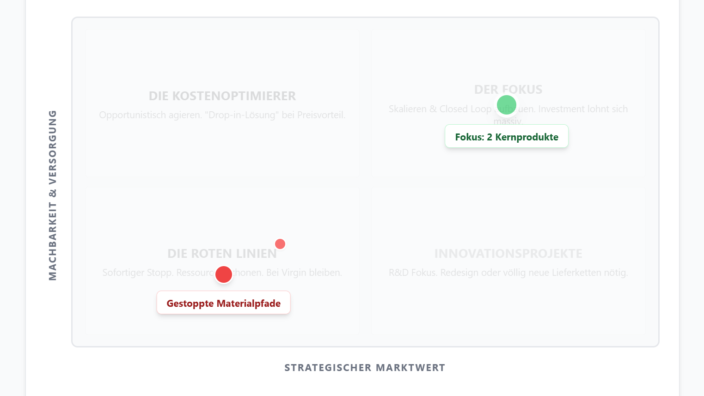
- Focus on 2 core products
- Stop unprofitable pathways
Impact: Approx. €870k total effect
- Savings from discontinued initiatives: ~€430k
- Cost reduction (offsetting virgin/recyclate price volatility): ~€110k
- Avoided regulatory costs: ~€170k
- Avoided production downtime through targeted closed-loop setup: ~€160k
Initial Situation:
- More than 40 components
- Significant OEM pressure regarding recyclates and CO₂ reduction
Key Insight:
- Only approx. 30% commercially viable
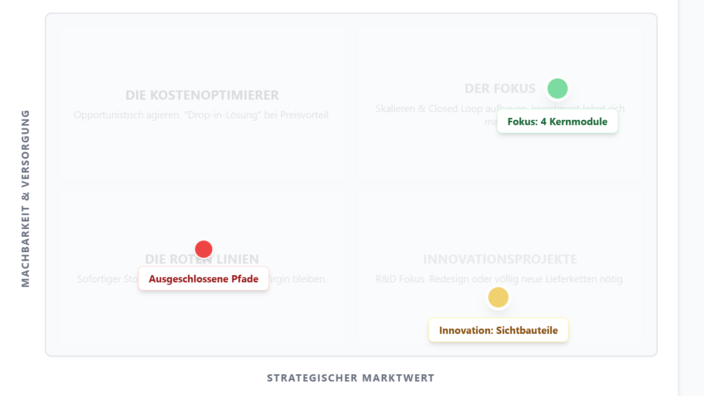
- Visible components immediately became margin-negative
Decision:
- Focus on 4 modules with genuine market demand
- Deliberately leave ~50% of the portfolio unchanged
Impact: Approx. €970k total effect
- Avoided failed developments & R&D costs: ~€450k
- Supply chain stabilisation (through recycling of in-house waste): ~€120k
- Avoided regulatory costs: ~€180k
- Sales uplift & OEM differentiation advantage: ~€220k
Initial Situation:
- More than 40 production lines
- High functional requirements
Key Insight:
- 60% technically viable
- However, failure risk (>15%) caused by inconsistent input streams
Decision:
- Prioritised two core production lines
- High-risk pathways excluded despite theoretical cost advantages
Impact: Approx. €950k total effect
- Avoided scrap and failed developments: ~€500k
- Increased supply security & avoided bottlenecks: ~€150k
- Avoided regulatory costs & penalties: ~€140k
- Revenue increase through guaranteed material availability: ~€160k
What was done?
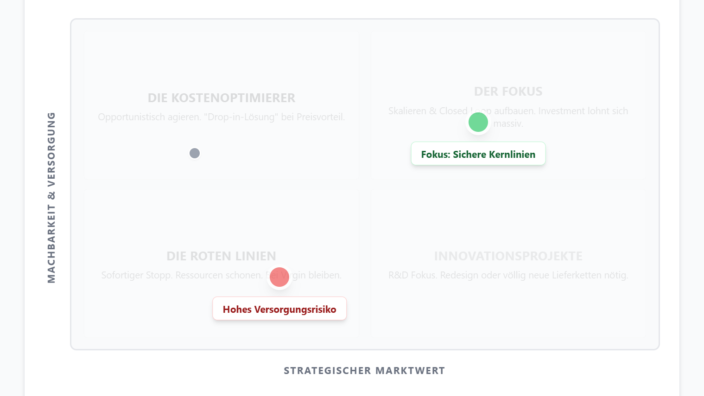
The company faced high technical performance requirements. The analysis identified a failure risk of more than 15% for specific recyclates due to fluctuating input quality (low supply-security score = red-line category).
Decision:
Two core product lines were prioritised. High-risk pathways were rigorously excluded despite theoretical price advantages.
Result:
Approx. €950k impact (supply security was considered strategically more important than pure material cost).
What was done?
With more than 40 components and significant OEM pressure, the company risked falling into reactive decision-making. The matrix immediately revealed that visible components would become margin-negative if converted to recyclates (high OEM pressure and market value, but extremely poor feasibility = innovation projects).
Decision:
Around 50% of the portfolio was consciously not transformed. Focus was placed on 4 modules with secured waste-stream recovery systems.
Result:
Approx. €970k impact (significant savings in development budgets and clear differentiation advantages with OEMs).
What was done?
The company faced high technical performance requirements. The analysis identified a failure risk of more than 15% for specific recyclates due to fluctuating input quality (low supply-security score = red-line category).
Decision:
Two core production lines were prioritised. High-risk pathways were rigorously excluded despite theoretical price advantages.
Result:
Approx. €950k impact (supply security was strategically prioritised over pure material cost).
1. The Assessment Logic (Scoring Model)
The tool evaluates the project based on 10 core questions. Instead of relying on intuition, it applies a transparent maturity scoring system:
- Yes (3 points): Requirement fully met / solution already exists
- Partially (1 point): Initial approaches exist, but significant adaptations are required
- No (0 points): Requirement not fulfilled or blocks implementation
2. The Two Strategic Dimensions (The Axes)
The collected scores are not simply added together. Instead, they are allocated across two strategic dimensions:
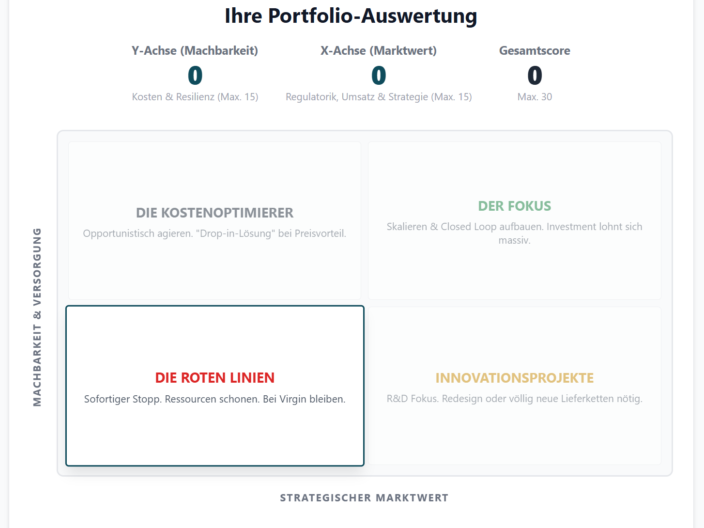
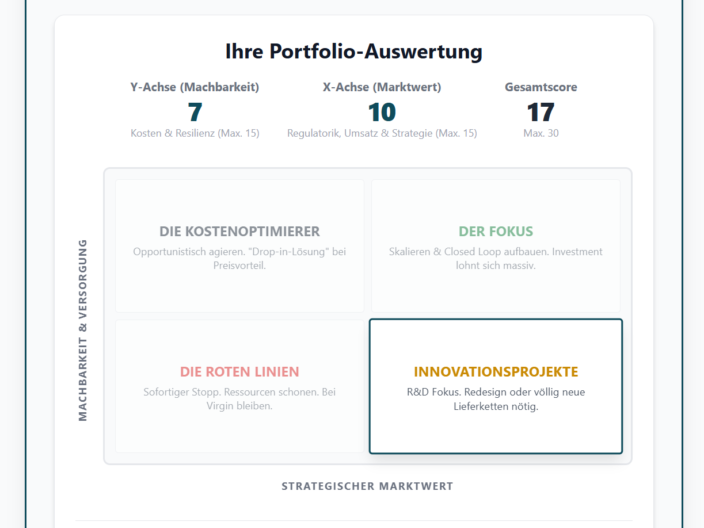
- Y-Axis (Feasibility & Supply Security)
How easy is the project to implement technically, and how stable is access to the required waste streams? (Focus: design, quality, and supply chain)
- X-Axis (Strategic Market Value)
Is there a genuine business case? (Focus: customer willingness to pay, margin potential, and regulatory pressure)
3. The Four-Quadrant Matrix (The Outcome)
Based on the position along the X and Y axes, the project is automatically classified into one of four strategic action fields:
🟢 The Focus (High / High) – The “sweet spot”. High feasibility meets strong customer willingness to pay. This is where investment and scaling should happen.
🟡 The Cost Optimisers (High Feasibility / Low Value) – Technically simple, but not a commercial differentiator. These should only be pursued opportunistically (e.g. low-cost drop-in solutions).
🟠 The Innovation Projects (Low Feasibility / High Value) – The market (OEMs) demands it, but the product or supply chain is not yet ready. These require dedicated R&D work and often a product redesign.
🔴 The Red Lines (Low / Low) – Economically and technically unattractive. The tool provides a robust argument for immediate project termination.
The Value of the Methodology: The framework immediately demonstrates to processors that they do not need to convert their entire portfolio to recycled materials — which often leads to failure. Instead, it identifies, in a measurable and data-driven way, the 30–60% of applications where a closed-loop approach truly creates economic value.
Stop wasting resources on uneconomic activism in the wrong portfolio quadrants. Let us review your checklist together – in a structured, data-driven, and results-oriented way.